

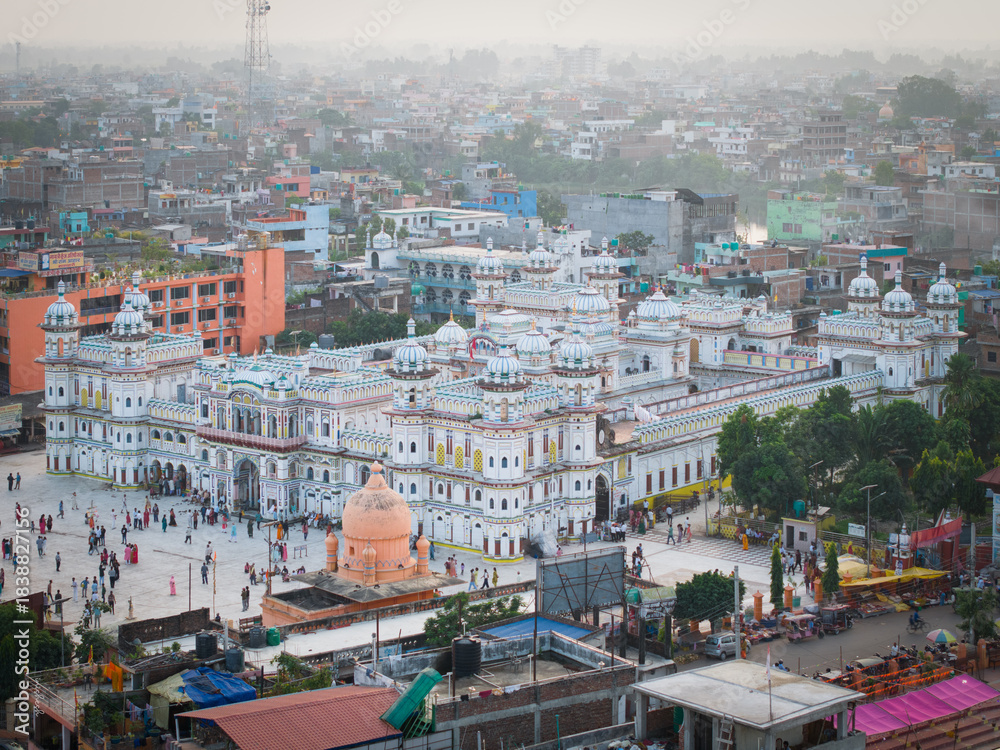
As the sun rises over Nepal’s Terai plains, the white marble façade of Janaki Mandir glows softly against the pastel sky. Temple bells ring in rhythm with morning chants. Pilgrims, some barefoot and some carrying flowers, move quietly toward the sanctum. This is not just another temple visit. This is Janaki Mandir, the spiritual heart of Janakpur Dham.
Also known as Janaki Temple, Janakpur Mandir, and Ram Janaki Temple, this iconic shrine is dedicated to Goddess Sita (Janaki), the daughter of King Janak and the divine consort of Lord Ram. For millions of Hindus across Nepal, India, and the entire globe, Janaki Mandir represents purity, devotion, and the sacred ideal of marriage.
What makes Janaki Mandir extraordinary is not only its mythology but also its identity. Architecturally, it bears no resemblance to the pagoda-style temples for which Nepal is famous. Instead, it resembles a Rajput palace with Mughal domes, standing tall in the flat Terai landscape. Built in the early 20th century by Queen Vrisha, it is today the largest temple in Nepal and one of the country’s most visited pilgrimage sites.
Located just 20 km from the India–Nepal border, Janakpur feels culturally closer to North India than Kathmandu. The rickshaws replace taxis, Maithili is widely spoken, and the summers are intensely hot. Yet spiritually, Janaki Mandir belongs to all of South Asia.
This 2025-26 complete guide covers everything you need to know: history, mythology, architecture, festivals, how to reach it, where to stay, and insider & accommodation tips, making it one of the most comprehensive English resources on Janaki Mandir available online.
| Feature | Details |
| Location | Janakpur Dham, Dhanusha District, Madhesh Pradesh, Nepal |
| Also Known As | Janaki Temple, Janakpur Mandir, Naulakha Mandir |
| Built | Completed in 1911 |
| Commissioned By | Queen Vrisha Bhanu Kunwari of Tikamgarh, India |
| Architecture | Mughal–Rajput with Mithila art |
| Material | White marble and stone |
| Area | ~1,480 sq meters (3 stories, ~60 rooms) |
| Entry Fee | Free |
| Opening Hours | 5:30–11:00 AM & 4:00–8:30 PM |
| Major Festival | Vivah Panchami (Nov 25, 2025) |
| Nearest Airport | Janakpur Airport (6 km) |
Janakpur’s sanctity predates the temple by thousands of years. According to the Ramayana, King Janak, ruler of the Mithila kingdom, discovered an infant girl while plowing a sacred field. He named her Sita, believing her to be a divine gift from Mother Earth.
Sita grew up in Janakpur, and when she came of age, King Janak announced her swayamvar (ceremony done before marriage). Princes from across kingdoms attempted to lift and string the mighty bow of Lord Shiva. Only Lord Ram, prince of Ayodhya, succeeded in breaking the bow and winning Sita’s hand in marriage.
This divine wedding transformed Janakpur into one of Hinduism’s most sacred landscapes.
The current Janaki Mandir was commissioned by Queen Vrisha Bhanu Kunwari of Tikamgarh (Orchha State), India. A devout follower of Goddess Sita, the queen reportedly experienced a spiritual vision that inspired her to construct a grand temple at Janakpur.
Construction began sometime between 1898 and 1910 (historical sources differ) and was completed in 1911. The project took over a decade, employing artisans, masons, and craftsmen from across the region.
Janaki Mandir is famously known as Naulakha Mandir because its construction cost nine lakh (900,000) gold coins, which was an astronomical amount at the time. The name reflects both the immense financial investment and the priceless devotion behind the structure.
Janaki Mandir symbolizes the deep religious connection between Nepal and India. While Sitamarhi in Bihar is also associated with Sita’s birth, Janakpur is universally revered as the site of her marriage. Even today, pilgrims freely cross borders to visit this sacred place, especially during major festivals.
Janaki Mandir is inseparable from the story of Ram and Sita, which embodies dharma (righteousness), devotion, sacrifice, and ideal marriage. The nearby Vivah Mandap marks the ceremonial wedding site, where rituals are reenacted every year.
For newly married couples, visiting Janaki Mandir is considered especially auspicious. Women devotees see Sita as a symbol of resilience, dignity, and strength and a source of inspiration.
Vivah Panchami (Nov 25, 2025): Week-long celebration of Ram-Sita wedding; 300,000–400,000 pilgrims
Ram Navami: Birth anniversary of Lord Ram
Deepawali/Tihar: Temple illuminated with thousands of lights
Chhath Puja: Rituals at nearby sacred ponds
During these festivals, Janakpur transforms into one of the most vibrant spiritual hubs in South Asia.
Unlike most temples in Nepal, Janaki Mandir follows a Mughal–Rajput architectural style, blending palace aesthetics with religious symbolism.
Key influences include
Mughal arches and domes
Rajput-style balconies and symmetry
Mithila (Maithili) art motifs
This makes it one of the most architecturally distinctive temples in the country.
Gleaming white marble façade
Three large domes and four corner turrets
Ornate railings and arches
Evening illumination that transforms the temple into a glowing landmark
The interior houses nearly 60 rooms, decorated with:
Colored glass windows
Mithila murals
Shrines dedicated to Ram and Sita
Photography is permitted in outer areas but not inside the inner sanctum.
From Kathmandu
Flight: 30 minutes (most convenient)
Bus: 7–9 hours (budget option)
Car: 5–6 hours via Sindhuli Road
From India
Train: Jaynagar (Bihar) to Janakpur Dham
Road: Via Jaynagar border crossing
Entry is free for all, including non-Hindus
Shoes must be removed
Dress modestly (covered shoulders and knees)
Best experience during morning or evening aarti
Best: October–December (pleasant weather)
Avoid: April–June (extreme heat up to 40°C)
Popular options include:
Hotel Janakpur Inn: Best overall, close to the temple
Mithila Yatri Niwas: Closest, pilgrim-focused
Bhagwati Guest House: Budget-friendly
Anjani Suite: Upper mid-range comfort
Hotel Sitasharan: Pilgrim-focused, shuttle for visit, sightseeing package
Festival Tip: Book accommodation 2–3 months in advance for Vivah Panchami.
Visit early morning to avoid crowds
Evening Aarti offers the best atmosphere
Carry socks as marble floors get hot
Try local Mithila food after your visit
Combine your trip with nearby sacred ponds and temples
Janaki Mandir is not just a place of worship; it is where mythology, architecture, and living tradition meet. From its royal origins and cross-border spiritual importance to the emotional grandeur of Vivah Panchami, this temple offers an experience that goes far beyond sightseeing.
For pilgrims, it is sacred ground. For travelers, it is a cultural immersion experience. For history lovers, it is a masterpiece in marble.
Continue Exploring Janakpur: Try this complete Janakpur Travel Guide